News

What Makes a 1000V DC Combiner Box 3 In 1 Out MCB Type Essential for PV Projects

2026-08-18 0 Leave me a message

The 1000V DC Combiner Box 3 In 1 Out MCB type from Soutya is a compact string-combination unit designed for photovoltaic systems. It merges three DC inputs into a single output while integrating a DC miniature circuit breaker for overcurrent protection. This product belongs to the broader combiner box category at Soutya, where engineers and procurement teams can evaluate multiple enclosure options for solar projects.

Table of Contents

  • What Is a 1000V DC Combiner Box 3 In 1 Out MCB Type?
  • Why Do Solar Projects Need a Dedicated DC Combiner Box?
  • How Does the 3 In 1 Out Configuration Benefit System Design?
  • What Role Does the MCB Play in Overcurrent Protection?
  • Which Safety Standards Apply to 1000V DC Combiner Boxes?
  • How Should Buyers Compare Different Combiner Box Options?
  • What Installation Considerations Should Engineers Keep in Mind?
  • Why Is Choosing a Reliable Supplier Like Soutya Important?

Key Points

  • Aggregates three PV strings into one protected output.
  • Uses a DC MCB for resettable overcurrent protection.
  • Rated for 1000V DC, suitable for modern high-voltage solar arrays.
  • Reduces balance-of-system costs and simplifies inverter connections.
  • Aligned with IEC 62548 and IEC 61643-11 for PV array design and surge protection.

What Is a 1000V DC Combiner Box 3 In 1 Out MCB Type?

A 1000V DC Combiner Box 3 In 1 Out MCB type is an electrical enclosure that collects three photovoltaic string circuits and combines them into a single DC bus. It is equipped with a miniature circuit breaker (MCB) rated for DC operation, providing overcurrent and short-circuit protection for each string. The 3 in 1 out configuration is common in residential and small commercial solar installations where three strings need to be brought together before feeding an inverter.

Soutya's model is built for 1000V DC systems, which are standard in utility and distributed-generation projects. The MCB is accessible from the front, allowing operators to disconnect a string manually or after a fault without opening the enclosure fully. This design keeps maintenance simple while maintaining a high degree of safety for personnel.

Why Do Solar Projects Need a Dedicated DC Combiner Box?

Without a combiner box, each PV string would need its own protected feeder cable running to the inverter. That approach multiplies cable length, termination points, and protection hardware. A DC combiner box centralizes string interconnection, protection, and isolation in one location. It also provides a single point for maintenance and troubleshooting.

In a 1000V DC Combiner Box, the MCB serves as both a protective device and a disconnection switch. In systems with high string voltage, a dedicated enclosure reduces the risk of accidental contact with live terminals and keeps wiring organized. It also simplifies compliance with electrical codes because the arrangement of conductors and protective devices is cleaner and more predictable.

How Does the 3 In 1 Out Configuration Benefit System Design?

The 3 in 1 out layout means the combiner box accepts three positive and three negative inputs, or three two-wire strings, and outputs one positive and one negative pair. This reduces the number of downstream feeder cables by two-thirds compared to running each string to the inverter. For a project with tight conduit space or limited inverter input terminals, this is a meaningful simplification.

From a design standpoint, a 3 in 1 out MCB type combiner box also allows installers to use a lower-rated output cable because the combined current is still modest at the 1000V level. The enclosure can be mounted close to the array to keep string lengths short. Soutya's version is useful for small arrays that need only three strings but still require professional protection and a clean interface.

What Role Does the MCB Play in Overcurrent Protection?

The MCB in a 1000V DC Combiner Box is rated for direct current, which is different from an AC MCB. DC arcs are harder to extinguish because the current does not pass through zero naturally. A DC-rated MCB uses special arc-quenching mechanisms to interrupt fault currents reliably. The MCB protects the string cables from overcurrent conditions caused by reversed polarity, short circuits, or insulation failures.

Compared to fuses, an MCB offers the advantage of resettability. When the fault is cleared, the MCB can be switched back on without replacing parts. This reduces downtime and spares inventory, which is critical in remote or hard-to-access installations. The MCB also provides visible indication of its state, making it easier for maintenance crews to identify the affected string.

Which Safety Standards Apply to 1000V DC Combiner Boxes?

Designing and installing a 1000V DC combiner box requires adherence to international standards. IEC 62548:2016 sets out requirements for PV arrays, including overcurrent protection, cable sizing, and isolation. While the standard covers the entire array, its guidelines influence where and how a combiner box is installed. IEC 61643-11:2011 applies to surge protective devices (SPDs) in low-voltage systems and is relevant when the combiner box includes SPDs for lightning and switching surge protection.

For combiner boxes without SPDs, the enclosure still needs to meet the electrical spacing and thermal requirements implied by these standards. A reputable supplier like Soutya manufactures the 1000V DC Combiner Box with adequate creepage distances, heat dissipation, and mechanical strength, so system integrators can confidently deploy the product in a compliant installation.

Note: The MCB rating must be coordinated with the maximum string current and the cable ampacity. Always verify that the selected combiner box has a sufficient breaking capacity for the fault level of the array.

How Should Buyers Compare Different Combiner Box Options?

When comparing combiner boxes, buyers should look beyond the number of inputs and outputs. The protection mechanism is a key differentiator. While some units use fuses, the MCB type offers resettable protection and easier operation. The table below compares typical attributes of MCB-based and fuse-based DC combiner boxes.

AttributeMCB TypeFuse Type
Overcurrent protectionReset via switchReplace fuse
Operator indicationVisible trip state hidden
Downtime after faultMinutes to resetRequires spare fuse
Enclosure spaceCompact, integrated switchRequires fuse holders
Typical costMediumLower initial cost
MaintenanceLowModerate

Buyers should also compare IP rating, terminal size, operating temperature range, and the quality of the DC MCB itself. A Soutya combiner box is engineered with high-grade materials and a tight sealing design, which helps protect internal components from moisture and dust.

What Installation Considerations Should Engineers Keep in Mind?

Mounting the 1000V DC Combiner Box in a well-ventilated, shaded area extends its lifetime. The enclosure should be positioned so that cables are not strained at the entry points and that the IP rating is maintained. Grounding must be connected via the provided terminal to protect personnel and equipment.

Before energizing, verify polarity on each string and confirm that the MCB is in the off position. The 3 in 1 out design means input circuits must be labeled to avoid confusion. In installations where surge protection is required, an SPD can be added upstream or downstream of the combiner box, depending on the design philosophy.

Why Is Choosing a Reliable Supplier Like Soutya Important?

The long-term performance of a combiner box depends on manufacturing consistency and material quality. Soutya specializes in DC distribution components and understands the operating conditions of solar plants. Every 1000V DC Combiner Box 3 In 1 Out MCB type is built with a robust enclosure, properly rated terminals, and a tested DC MCB. The company's product documentation and technical support help engineers integrate the unit with confidence.

Vendors who offer only generic AC-rated components fail to meet DC-specific requirements. By selecting Soutya, buyers gain access to a supplier focused on the solar industry, with a proven track record in high-voltage DC enclosures. The combiner box category page provides additional configurations for different project scales.

References

  • IEC 62548:2016 Photovoltaic (PV) arrays – Design requirements [S].
  • IEC 61643-11:2011 Low-voltage surge protective devices – Part 11: SPDs connected to low-voltage power systems [S].

Asked Questions

Is a 3 in 1 out combiner box enough for a typical residential solar system?

For systems with three strings or fewer, a 3 in 1 out unit is a practical choice. It provides one protected output, saving space and reducing wiring compared to individual string protection.

Can the MCB in a 1000V DC combiner box be used for AC circuits?

No. The MCB is rated for DC use. Using it on an AC circuit would violate its intended application and could lead to unsafe operation.

How should the MCB be inspected?

Periodic inspection, at least once per year, is recommended to verify that the MCB trips correctly and that the enclosure remains sealed. In dusty or humid environments, more frequent checks are advised.

Does the combiner box include surge protection?

This specific 3 in 1 out model is not equipped with SPDs as standard. If surge protection is required, external SPDs can be added at the same location.

Need a reliable DC string aggregation solution? The Soutya 1000V DC Combiner Box 3 In 1 Out MCB type combines quality, safety, and ease of use. Visit the product page to request pricing or samples for your next project.

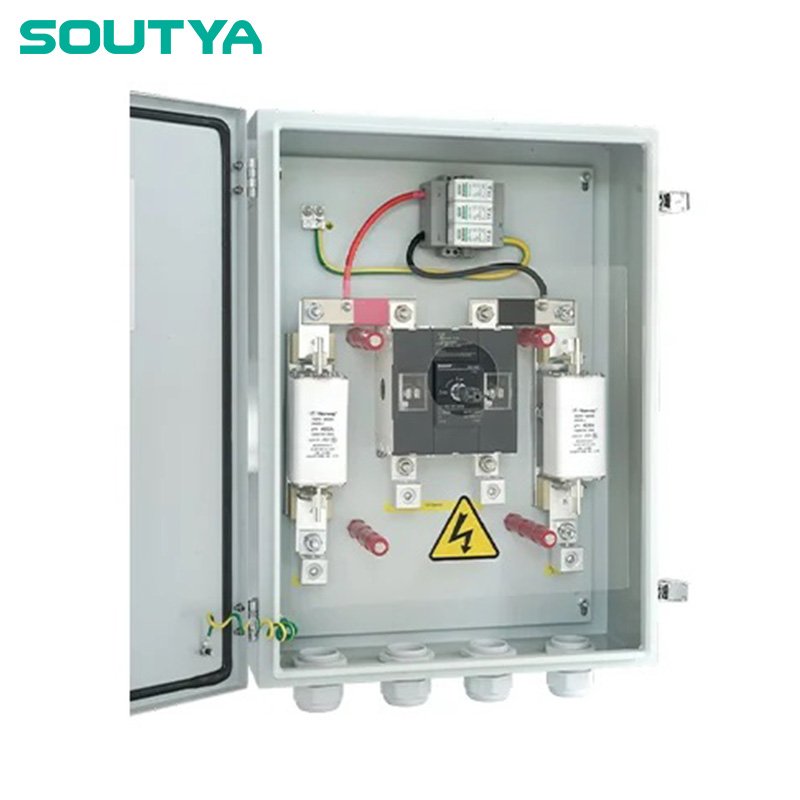
1000V DC Combiner Box 3 In 1 Out MCB type by Soutya
Related News
Leave me a message
X
We use cookies to offer you a better browsing experience, analyze site traffic and personalize content. By using this site, you agree to our use of cookies.Privacy Policy
RejectAccept