This article covers the role of the Soutya DC Isolator Box IP65 Enclosure Four Strings in solar PV systems, compares it with distributed isolators, explains the importance of IP65 protection, and provides selection guidance for engineers and procurement teams.
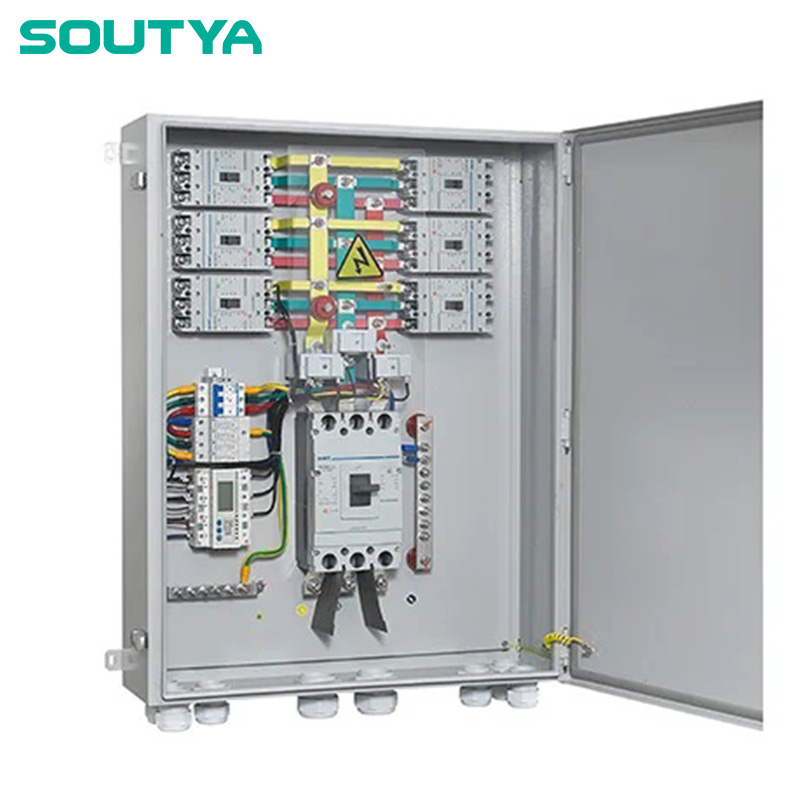
Photovoltaic arrays generate direct current that must be combined, isolated, and protected before reaching the inverter. A DC Isolator Box IP65 Enclosure Four Strings acts as a central hub that gathers four PV strings and provides a single disconnect point for maintenance and emergency shutdown. This configuration reduces component count and simplifies wiring, which lowers installation and troubleshooting costs.
Compliance with IEC 62548:2016 is a core requirement for PV array electrical design. The standard specifies isolation, overcurrent protection, and cable entry requirements. A purpose-built combiner box from Soutya is engineered to meet these obligations, whereas improvised assemblies fail to deliver consistent insulation or arc protection.
Using four separate DC isolators means four enclosures, more mounting points, and a tangle of cables. A four-string combiner box centralizes switching, fusing, and optional monitoring into one IP65-rated housing. The maintenance team gains a single access point, and the system footprint shrinks .
| Feature | Standalone Isolators | Soutya Four-String Combiner Box |
|---|---|---|
| Number of enclosures | 4 | 1 |
| Wiring points | Multiple, distributed | Centralized |
| IP rating | IP54 or lower | IP65 |
| Service access | Multiple locations | Single lockable cover |
| Expansion flexibility | Limited, requires new enclosures | Compact, supports standard string counts |
The Soutya DC Isolator Box IP65 Enclosure Four Strings is designed to replace this distributed setup with a single, robust unit. For rooftop and ground-mount projects, this consolidation reduces installation hours and minimizes potential points of failure.
IP65 means the enclosure is dust-tight and protected against low-pressure water jets from any direction. Solar arrays are exposed to rain, dust, and condensation. If moisture enters a DC enclosure, it can corrode contacts and compromise insulation, leading to arc faults or short circuits.
The contacts inside the DC isolator must also handle DC arcs, which do not self-extinguish as as AC arcs. Research on low-voltage DC switch contact electrodes shows that material selection and chamber design affect contact endurance and arc interruption capability. Soutya applies this engineering knowledge to its isolator switches, ensuring repeated safe operation under load.
This combiner box is well suited for commercial rooftop systems, industrial carports, small utility-scale ground mounts, and agricultural PV installations. Four-string inputs match common inverter MPPT configurations, making the unit a straightforward choice for new builds and retrofits.
When the array layout is distributed across different roof planes or tracking rows, using a central four-string box reduces DC cable runs and voltage drop. The IP65 enclosure allows installation in exposed locations without additional weatherproofing.
Before specifying a DC Isolator Box IP65 Enclosure Four Strings, check the maximum input voltage ( up to 1000V DC), per-string current rating, output current rating, and the isolator switch rating. Also verify the number of string inputs, cable entry sizes, and whether the unit supports fusing or monitoring options.
Because these parameters affect safety and system compatibility, procurement teams should request the official datasheet from Soutya. Confirming that the product is tested to relevant standards prevents field failures and compliance issues.
It combines four DC input strings from a photovoltaic array into one output, while providing a manual isolation point for safe maintenance and emergency shutdown. The IP65 enclosure protects the internal components from outdoor exposure.
IP65 rating ensures protection against dust ingress and water jets, which is essential for rooftop or ground-mounted installations exposed to rain, wind, and contaminants. It extends the service life of the isolator and wiring.
Residential systems use fewer than four strings, but the unit can still be used as a busbar or disconnection point. It is more specified for commercial and small utility systems where multiple strings are standard.
Soutya designs DC isolators with materials and arc-chamber geometries proven in low-voltage DC switching applications. Each enclosure undergoes routine inspection and testing to confirm dielectric strength, mechanical endurance, and IP protection.
The design follows the principles of IEC 62548:2016 for PV array electrical safety. The isolator switch contacts are engineered in line with research on low-voltage DC contact endurance and arc interruption.
The Soutya DC Isolator Box IP65 Enclosure Four Strings is available now. View full specifications and request a quote by visiting the product page.
[1] IEC 62548:2016. Photovoltaic (PV) arrays — Design requirements [S]. 2016.
[2] Aging Characteristics of Contact Electrodes of Low Voltage DC Switches. Energies, 2021, 14(20): 6838.

Jack
Soutya