News

230V 400V AC Combiner Box 4 In 1 Out: What Engineers Must Know

2026-09-06 0 Leave me a message
Product Summary: The 230V 400V AC Combiner Box 4 In 1 Out from Soutya combines four AC input circuits into one output bus. Designed for commercial solar, UPS, and backup power systems, this Soutya combiner box integrates overcurrent protection, surge protection, and disconnection in a single enclosure. This article explains the technical role of a 4-in-1-out AC combiner box, its essential protection features, and how to select the correct model for low-voltage distribution projects.
Article Outline
  • Definition and application context of the 230V 400V AC combiner box
  • How four input circuits are aggregated into one protected output
  • Key protection and monitoring components that meet IEC standards
  • Comparison of the Soutya 4-in-1-out unit with conventional parallel wiring
  • Selection criteria, wiring guidelines, and compliance notes

Soutya 4-In-1-Out AC Combiner Box vs. Unprotected Parallel Connections

Feature Soutya 230V 400V AC Combiner Box 4 In 1 Out Direct Parallel Termination (No Combiner Box)
Input circuits 4 independent AC inputs (phase + neutral + PE) Multiple cables twisted together
Overcurrent protection Per-input MCB or fuses Not provided
Surge protection Integrated Type 2 SPD Not provided
Disconnection Main output breaker plus per-input breakers No isolating means
Enclosure rating IP54 or higher steel enclosure None
Installation labor Pre-wired, plug-and-play High, error-prone
Maintenance Clear labels, individual circuit isolation Difficult and hazardous

What Is a 230V 400V AC Combiner Box and Why Is It Needed?

An AC combiner box is an electrical enclosure that aggregates several alternating current sources or loads into a single common bus. The 230V 400V AC Combiner Box 4 In 1 Out accepts four three-phase or single-phase AC feeder circuits and combines them into one outgoing feeder. The voltage rating of 230V/400V corresponds to the standard European low-voltage distribution system, where single-phase voltage is 230V and three-phase line-to-line voltage is 400V.

In many commercial installations, multiple inverters, generators, or UPS modules must feed a shared transformer or distribution panel. Connecting their outputs in parallel without proper protection creates risk of reverse current, overcurrent, and fault propagation. The Soutya 4-in-1-out combiner box solves this by providing a structured busbar arrangement, dedicated overcurrent protection for each input, and a clear disconnection point. This arrangement is widely used in rooftop solar plants, data center backup systems, and industrial microgrids where several AC sources need to be safely combined.

Compliance with design rules is mandatory. According to IEC 62548:2016, which covers PV array design requirements, DC and AC combiner equipment must include appropriate overcurrent protection and disconnection means for each source circuit. Even though that standard focuses on photovoltaic arrays, the same engineering logic applies to any distributed AC source that feeds a common bus. A dedicated Soutya AC combiner box ensures that the installation follows a recognized protection pattern than an improvised parallel connection.

Note: The 230V 400V rating means the combiner box is suitable for TN-S or TN-C-S systems used in Europe, Africa, and parts of Asia. For 120/208V systems, a different AC combiner box with corresponding ratings is required.

How Does a 4-In-1-Out AC Combiner Box Simplify Inverter and Load Wiring?

Without a combiner box, connecting four inverters to a single AC bus requires installing four separate breaker enclosures, four sets of surge protectors, and a complex network of cables that terminate on the main busbar. This piecemeal approach increases installation time, occupies panel space, and introduces more potential connection points where faults can develop.

The Soutya 4 in 1 out combiner box consolidates all these functions into one pre-wired unit. Each input channel has a circuit breaker or fuse that protects its individual source. The internal busbar brings the four circuits together, and the single output feeds the main distribution board or transformer. This configuration reduces labor costs on site because the installer only needs to terminate the incoming cables and the outgoing cable. There is no need to assemble separate protection units.

Maintenance also becomes simpler. An engineer can isolate one input breaker without switching off the whole output bus, allowing one inverter or load branch to be serviced while others continue operating. For a solar plant operator, this increases system availability. The clear labeling and transparent cover on many Soutya combiner boxes allow quick visual inspection of breaker status and surge protector operation.

Typical applications for the 230V 400V AC combiner box include:

  • Combining output from three-phase solar inverters before connecting to the AC distribution board
  • Aggregating multiple UPS module outputs in a parallel redundancy configuration
  • Bringing together generator circuits that feed the same emergency power bus
  • Combining charge inverter outputs in a large commercial battery storage system

Which Protection Features Should a 230V 400V AC Combiner Box Include?

When specifying a combiner box for AC circuits, engineers must verify that the enclosure provides at least four protection layers: overcurrent, surge, short-circuit, and personnel safety. The Soutya 230V 400V AC Combiner Box 4 In 1 Out is built these basic principles.

Overcurrent Protection

Each of the four inputs must be separately protected against overload and short circuit. This is achieved with miniature circuit breakers (MCBs) or fuses rated according to the cable size and the source capacity. Using per-input breakers prevents a fault in one source or its feeder from dragging down the whole combiner bus.

Surge Protection

AC combiner boxes connected to outdoor inverters or long cable runs are exposed to lightning-induced surges and switching overvoltages. A Type 2 surge protective device (SPD) is recommended at the combiner box location to limit transient voltages before they reach sensitive inverter electronics. The SPD must comply with IEC 61643-11:2011, which specifies performance and safety requirements for low-voltage surge protection devices.

Disconnection and Isolation

A lockable main output breaker or switch disconnector provides a visible break between the combined bus and the downstream load. This is necessary for safe maintenance of the transformer or distribution panel., each input breaker provides independent isolation, enabling safe work on individual sources.

Enclosure Protection

Because the combiner box is installed indoors near the inverters or outdoors in a protected area, the enclosure should have an IP rating suitable for the environment. Soutya AC combiner boxes use a wall-mounted steel or ABS enclosure with IP54 or higher protection, giving resistance to dust and splashing water. A transparent or semi-transparent door is preferred for checking breaker states without opening the box.

Why Choose Soutya's 230V 400V AC Combiner Box 4 In 1 Out for Commercial Projects?

Soutya, a specialist in low-voltage electrical distribution equipment, designs its AC combiner boxes for demanding commercial and industrial applications. The 4-in-1-out model delivers several practical advantages over generic assemblies.

  • Pre-engineered internal wiring: Busbars are sized to handle the combined input current without overheating. The internal wiring pattern has already been tested for short-circuit withstand.
  • Component quality: Soutya uses recognized circuit breakers, SPDs, and connectors that meet IEC and UL test requirements. This reduces the risk of failure caused by low-quality subcomponents.
  • Space saving: A single compact enclosure, 400×500×200 mm, replaces multiple separate breaker boxes. This reduces footprint in equipment rooms and PV skids.
  • Cost-effective installation: all wiring is done at the factory. Field wiring is limited to input feeders, output feeder, and optional monitoring cables. This reduces installation error and project labor hours.
  • Customization options: Soutya can tailor the enclosure to handle specific current ratings, add monitoring CTs, or provide a different number of inputs (e.g., 2-in-1-out, 6-in-1-out) based on project requirements.

For an engineering procurement contractor, choosing a pre-assembled Soutya combiner box simplifies the bill of materials and speeds up project schedules. It also shifts responsibility for protection coordination to a manufacturer that designs the box as a system than an enclosure with components bolted in.

How to Specify and Install the Soutya 230V 400V Combiner Box?

Correct specification begins by defining the number of input sources, their voltage and frequency, and the total expected output current. For a 230V/400V system, the combiner box must be rated for the maximum possible short-circuit current at the point of connection. The short-circuit rating of the breakers inside the box must be higher than the value calculated for the installation.

Engineers should also determine whether the system uses three-phase or single-phase inputs. The Soutya 4-in-1-out model can be configured with four three-phase inputs or with 12 single-phase poles depending on the internal bus design. Always confirm the wiring diagram with Soutya's technical team before ordering.

During installation, the following guidelines apply:

  • Mount the combiner box on a rigid vertical surface, away from heat sources and direct sunlight.
  • Select cable glands that match the enclosure's IP rating and the cable outer diameter.
  • Use copper conductors sized according to the output breaker current rating but never less than the cross-section specified by the manufacturer.
  • Verify that the neutral conductor is properly connected to the neutral busbar and that protective earth is bonded to the enclosure.
  • After termination, inspect the torque of all breaker and busbar connections. Loose connections are a frequent cause of heat rise and fire.
  • Test tripping functions of each input breaker and the main output breaker after energization.

It is equally important to maintain a minimum clearance between the combiner box and other equipment for safe door opening. Avoid installing the enclosure in an area where it may be exposed to water spray, unless the enclosure is specified with an IP65 rating. Following the manufacturer's instructions and IEC wiring rules will ensure safe and reliable operation.

Asked Questions

Q1: Can the 230V 400V AC combiner box be used with both single-phase and three-phase systems?

Yes. The Soutya 4-in-1-out AC combiner box is internally configurable. For a four three-phase input system, twelve poles are used, while for single-phase inputs, each input circuit uses one pole plus a shared neutral bus. Verify the model's exact configuration with the datasheet.

Q2: What is the difference between a DC combiner box and an AC combiner box?

A DC combiner box aggregates multiple photovoltaic string outputs and contains string fuses, a DC surge protector, and a DC disconnector. An AC combiner box operates on the inverter output side, combining multiple AC circuits with AC breakers, SPDs, and an AC busbar. The Soutya product discussed here is solely an AC combiner box.

Q3: What standards apply to a 230V 400V AC combiner box?

Relevant standards include IEC 61439 for low-voltage switchgear assemblies (though Soutya's unit may be tested as an assembly), IEC 61643-11:2011 for surge protective devices, and IEC 62548:2016 for PV array design requirements that reference combiner equipment. Installers must also follow IEC 60364 for electrical installations.

Q4: Can the combiner box handle unbalanced loads from different inputs?

Yes, but the combined output must not exceed the rating of the main busbar and output breaker. If one input carries more current than others, the neutral currents must be accounted for in the design, in three-phase four-wire systems. Soutya can provide options with oversized neutral busbar for such cases.

Q5: Is maintenance required for the surge protector inside the AC combiner box?

Yes. Type 2 SPDs have a finite lifespan and may fail after multiple surge events. Most Soutya combiner boxes include SPD status indicators with display windows. Engineers should check these indicators during periodic maintenance and replace the SPD module when it shows the end-of-life flag.

Select the Right 4-In-1-Out AC Combiner Box for Your Project

Soutya's 230V 400V AC Combiner Box 4 In 1 Out is engineered to simplify AC source aggregation while maintaining the protection and safety levels that professional installations demand. With pre-wired circuits, integrated surge protection, and a robust enclosure, this combiner box delivers a clean, low-risk solution for commercial solar, UPS, and industrial backup systems. Contact Soutya today to confirm the correct breaker configuration and receive a detailed wiring diagram for the 230V 400V 4-in-1-out model.

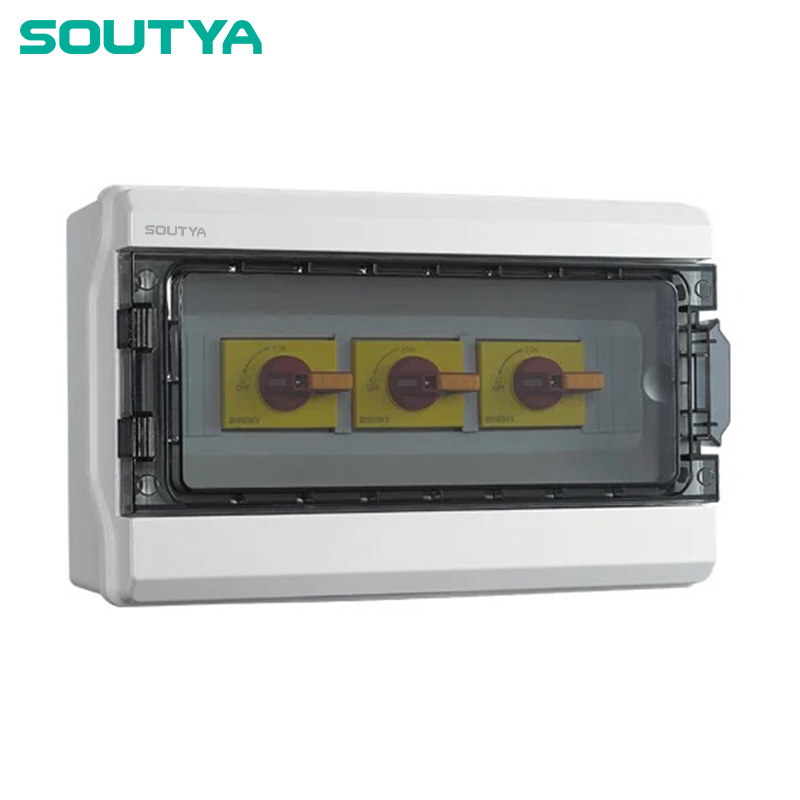
Soutya 230V 400V AC Combiner Box 4 In 1 Out enclosure for commercial solar and UPS installations

References

[1] IEC 62548:2016. Photovoltaic (PV) arrays – Design requirements [S]. Geneva: IEC, 2016.

[2] IEC 61643-11:2011. Low-voltage surge protective devices – Part 11: Surge protective devices connected to low-voltage power systems – Requirements and test methods [S]. Geneva: IEC, 2011.

[3] IEC 60947-4-1:2020. Low-voltage switchgear and controlgear – Part 4-1: Contactors and motor-starters – Electromechanical contactors and motor-starters [S]. Geneva: IEC, 2020.

Related News
Leave me a message
X
We use cookies to offer you a better browsing experience, analyze site traffic and personalize content. By using this site, you agree to our use of cookies.Privacy Policy
RejectAccept