News

What Makes a 1500V DC Surge Protective Device Essential for Solar and Storage Systems?

2026-06-10 0 Leave me a message

This article explains why a 1500V DC Surge Protective Device (DC SPD) is critical for high-voltage solar and battery storage systems. It covers operating principles, selection criteria, and compliance with IEC 61643-11 and UL 1449. Soutya offers reliable 1500V DC Surge Protective Devices designed for demanding B2B applications.

Table of Contents

  • Why do high-voltage DC systems need surge protection?
  • What common challenges do buyers face when selecting DC SPDs?
  • How does a 1500V DC SPD work to protect equipment?
  • Which 1500V DC SPD type fits your application?
  • How to verify compliance with international standards?
  • What installation practices improve SPD longevity?
  • FAQ

Why do high-voltage DC systems need surge protection?

Modern solar photovoltaic (PV) arrays and battery energy storage systems (BESS) operate at voltages up to 1500V DC to reduce current and improve efficiency. However, these higher voltages also increase vulnerability to transient overvoltages caused by lightning, switching operations, and grid faults. Without adequate surge protection, surges can destroy inverters, charge controllers, and monitoring equipment, leading to costly downtime and replacement. A 1500V DC Surge Protective Device is specifically designed to clamp excessive voltage spikes and divert surge current safely to ground, preserving system reliability.

What common challenges do buyers face when selecting DC SPDs?

Procurement engineers and EPC contractors often struggle with three issues: insufficient voltage rating, incorrect surge current capacity, and lack of standard compliance. Some SPDs rated for lower DC voltages fail catastrophically under 1500V DC stress. Others may have adequate voltage rating but inadequate surge current handling (Imax or Iimp). Additionally, many generic SPDs do not meet the rigorous testing requirements of IEC 61643-11 or UL 1449 for DC systems. Buyers must also consider environmental factors such as temperature extremes, humidity, and dust common in solar farms. A reliable DC SPD from a trusted supplier like Soutya eliminates these uncertainties through proper certification and application engineering support.

How does a 1500V DC SPD work to protect equipment?

A 1500V DC SPD uses metal oxide varistors (MOVs) or gas discharge tubes (GDTs) arranged in a series/parallel configuration to achieve the high voltage rating. Under normal conditions, the SPD presents a very high impedance. When a transient voltage exceeds the threshold, the SPD switches to a low-impedance path, conducting surge current and limiting the residual voltage (voltage protection level, Up) to a safe level for downstream equipment. For 1500V DC systems, SPDs are typically connected between each pole (positive and negative) and ground, and often between poles (Mode 2 or Mode 3 configuration per IEC 61643-11).

Note: Always check the maximum continuous operating voltage (Ucpv) of a DC SPD. It must be at least 1.2 times the system's open-circuit voltage (Voc) to avoid premature aging.

Which 1500V DC SPD type fits your application?

According to IEC 61643-11, SPDs are classified as Type 1 (for direct lightning strikes), Type 2 (for switching surges), and Type 3 (for equipment-level protection). For 1500V DC solar and storage systems:

  • Type 1 DC SPDs (Imax up to 50 kA, Iimp 12.5 kA per pole) are recommended for main distribution panels in large PV plants with external lightning protection.
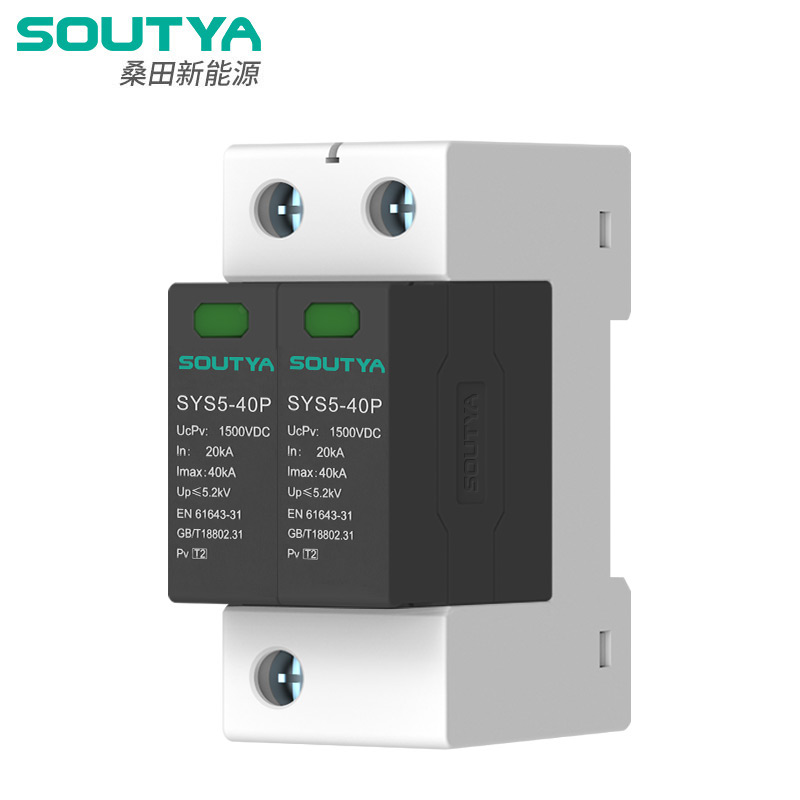
  • Type 2 DC SPDs (Imax 20-40 kA) suit combiner boxes and inverter inputs where the surge source is mostly from switching or indirect lightning.
  • Many SPDs combine Type 1+2 characteristics for flexibility.

Below is a comparison of typical 1500V DC SPD models from Soutya:

Model Type Max DC Voltage (Ucpv) Imax (8/20 µs) Iimp (10/350 µs) Up (at In)
SYD2-DC1500/40 Type 2 1500V 40 kA ≤ 4.0 kV
SYD1-DC1500/12.5 Type 1 1500V 50 kA 12.5 kA ≤ 3.8 kV
SYD1+2-DC1500/25 Type 1+2 1500V 50 kA 25 kA ≤ 3.5 kV

Selecting the right type ensures that the SPD can handle the expected surge energy while maintaining a low voltage protection level.

How to verify compliance with international standards?

When purchasing a 1500V DC SPD, insist on third-party certification according to IEC 61643-11:2011 and, if exporting to North America, UL 1449 (5th edition). IEC 61643-11 defines tests for voltage protection level, thermal stability, and surge current capability. UL 1449 updates ensure proper DC rating markings and require testing at maximum continuous operating voltage. Look for the certification mark on the product or request test reports from the supplier. Soutya SPDs are fully compliant with these standards, providing confidence for global projects.

What installation practices improve SPD longevity?

Proper installation is as important as the SPD itself. The following guidelines maximize protection and service life:

  • Mount the SPD as close as possible to the equipment to be protected (minimize lead length).
  • Use the shortest and straightest conductors (recommended cross-section ≥ 16 mm² copper).
  • Ensure the SPD's disconnector (if integrated) is rated for the system's short-circuit current.
  • Install appropriate overcurrent protection (circuit breaker or fuse) upstream of the SPD.
  • Regularly inspect the SPD status indicator (green/red) and replace after a major surge event.

FAQ

Q: Can I use a 1000V DC SPD on a 1500V DC system?

No. A 1000V DC SPD will be overstressed and likely fail rapidly, potentially causing a fire or loss of protection. Always match the SPD's maximum continuous operating voltage (Ucpv) to the system voltage.

Q: What is the difference between SPD types for AC and DC?

DC SPDs are specifically designed for non-sinusoidal DC voltage profiles. They have different operating voltage, leakage current, and arc extinguishing characteristics. Never substitute an AC SPD for a DC system.

Q: How often should a 1500V DC SPD be replaced?

Most SPDs have an end-of-life indicator. Even without visible damage, industry practice recommends replacement every 5-10 years or after a major surge event that causes the indicator to change.

Q: Do I need SPDs on both the DC and AC side of an inverter?

Yes. Transient surges can enter from either side. Install a 1500V DC SPD on the PV input and an appropriate AC SPD on the output side for complete protection.

Choosing the right 1500V DC Surge Protective Device is critical for asset protection and system uptime. Soutya offers a comprehensive range of Type 1, Type 2, and Type 1+2 DC SPDs that meet IEC 61643-11 and UL 1449 standards. To discuss your project requirements or request a quotation, visit our product page: 1500V DC SPD.

References
[1] IEC 61643-11:2011. Low-voltage surge protective devices – Part 11: SPDs connected to low-voltage power systems – Requirements and test methods. Geneva: IEC, 2011.
[2] UL 1449. Standard for Surge Protective Devices. 5th ed. Northbrook: UL Standards, 2021.
[3] IEC 62606:2013. General requirements for arc fault detection devices (AFDDs). Geneva: IEC, 2013.

Related News
Leave me a message
X
We use cookies to offer you a better browsing experience, analyze site traffic and personalize content. By using this site, you agree to our use of cookies. Privacy Policy
Reject Accept