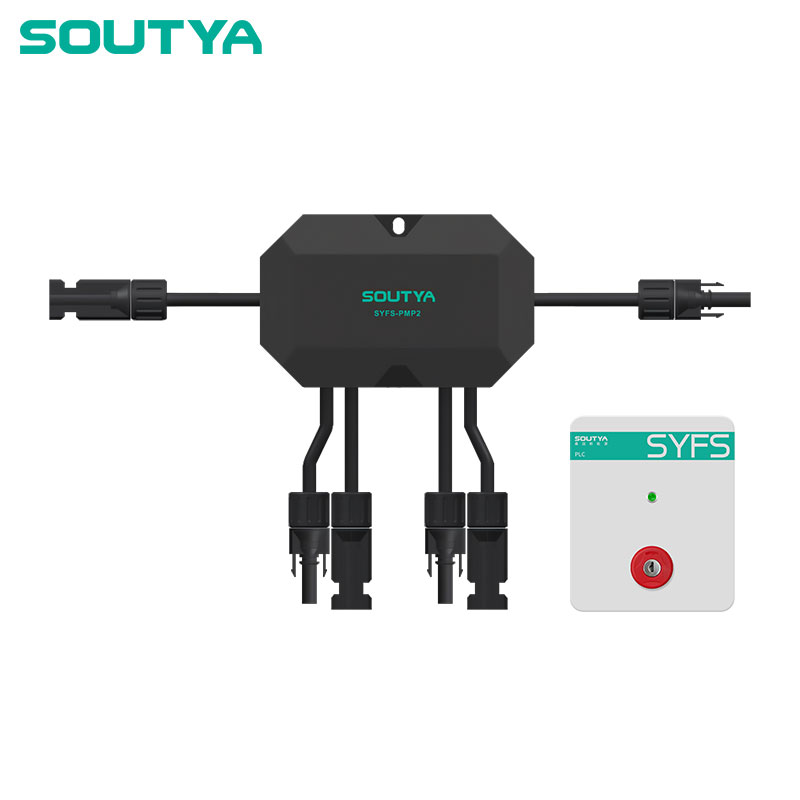
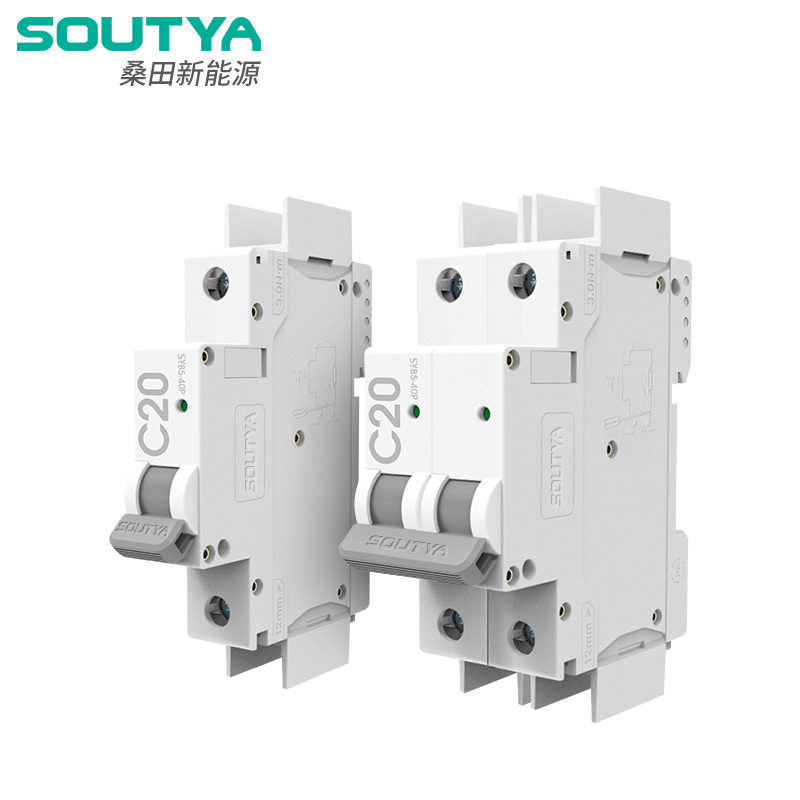
The Soutya PLC communication control rapid shutdown device ensures NEC 690.12 compliance for solar PV systems. This PLC communication control rapid shutdown device from Soutya integrates power line communication to instantly disconnect PV modules, reducing fire risk and meeting code requirements for building-mounted arrays.
A PLC (Power Line Communication) rapid shutdown device is a safety component used in photovoltaic (PV) systems to disable DC power from solar panels when required. The Soutya PLC communication control rapid shutdown device functions as a miniature circuit breaker that can be triggered remotely via existing power lines, eliminating the need for additional control wiring. It is designed to meet rapid shutdown requirements for building-mounted PV arrays, in residential and commercial rooftop installations.
Note: PLC communication uses the existing DC wiring to send control signals, reducing installation complexity and cost compared to wireless or separate control wire solutions.
Rapid shutdown is mandated by the National Electrical Code (NEC) 690.12 to protect firefighters and first responders from electrocution hazards when working on roofs with solar panels. The code requires that within 30 seconds of initiating shutdown, the voltage outside the array boundary be reduced to ≤80 V, and inside the array, conductors must be limited to ≤80 V or 12 A·s within the same time frame. The PLC communication control rapid shutdown device from Soutya provides a reliable method to achieve this compliance, automatically or manually activating disconnect when triggered by a PLC signal.
The Soutya device is installed at the point of entry into the building or on the array. It continuously monitors the power line for a specific PLC carrier frequency ( 50–150 kHz). When a shutdown command is sent from a transmitter (e.g., a fire switch or inverter signal), the device detects the signal and mechanically opens its internal contacts, disconnecting the PV module strings. The device operates as a miniature circuit breaker with arc extinguishing capability, ensuring safe interruption of direct current. It can be reset manually once the system is safe.
| Feature | PLC Communication | Wireless RF | Separate Control Wire |
|---|---|---|---|
| Installation cost | Low (uses existing wires) | Medium | High |
| Reliability | High (no battery) | Medium (interference) | High |
| Compliance with NEC 690.12 | Yes | Yes | Yes |
| Device type | MCB-based | Dedicated module | Contactor |
The Soutya PLC rapid shutdown device is built to industrial standards. Key parameters include:
These specifications ensure compatibility with most residential and commercial PV systems. The device functions both as a disconnect and as overcurrent protection, replacing the need for separate string combiners or DC breakers.
Choosing the correct device depends on system voltage, string current, and PLC compatibility. Consider the following factors:
The Soutya product line offers multiple ratings to fit common configurations. Consult a qualified engineer for detailed selection.
No. The device derives power from the PV string itself and only needs a PLC signal from a compatible transmitter.
Yes, if the existing wiring can carry PLC signals and the device voltage/current ratings match, retrofitting is possible.
Manually via an external handle or button, after the hazard is cleared and the PLC signal is removed.
Yes, it incorporates miniature circuit breaker functionality with thermal-magnetic trip for overload and short-circuit.
It complies with IEC 60947-2 and is listed for rapid shutdown according to NEC 690.12.
For reliable NEC 690.12 compliance and simplified installation, choose the Soutya PLC communication control rapid shutdown device. Contact Soutya for detailed specifications and OEM inquiries.
[1] NEC 690.12 (NFPA 70). Rapid Shutdown of PV Systems on Buildings. 2020.
[2] IEC 60947-2. Low-voltage switchgear and controlgear - Part 2: Circuit-breakers. 2019.
[3] GB/T 14048.2-2020. Low-voltage switchgear and controlgear - Part 2: Circuit breakers. 2020.


Jack
Soutya