News

Can I Use a DC Circuit Breaker for AC?

2026-01-14 0 Leave me a message

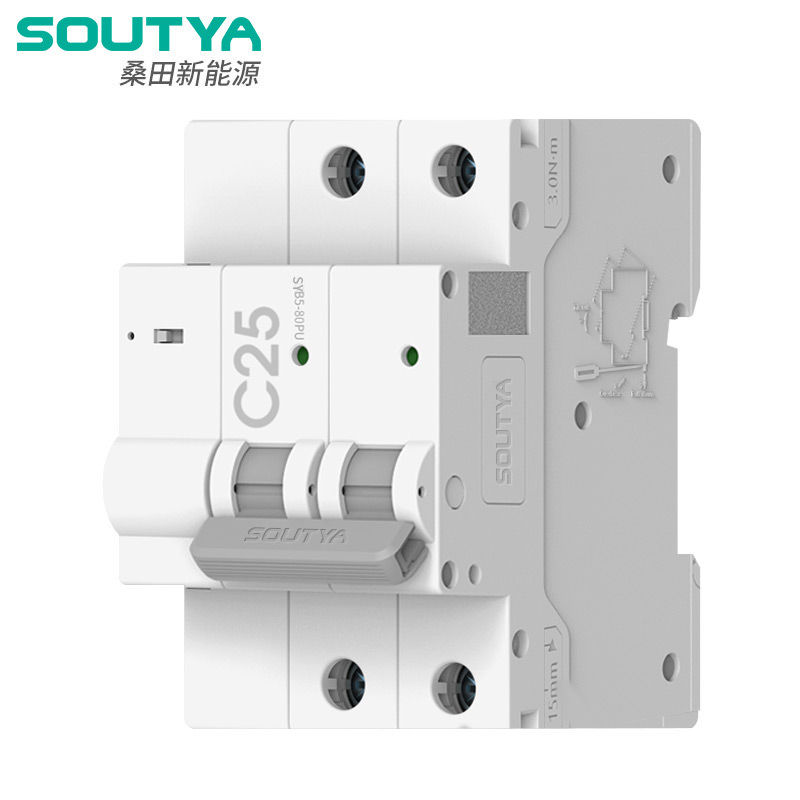
Can I use a DC circuit breaker for AC circuit? This is a common question in electrical work especially for projects involving renewable energy battery storage or home electrical setups. To answer it thoroughly we use the SYB5-40P High Voltage DC Miniature Circuit Breaker from Zhejiang Soutya New Energy as a reference. This widely used DC breaker highlights key reasons why DC and AC circuit breakers are not interchangeable.

Direct current and alternating current have different electrical behaviors. Direct current flows in one direction , alternating current swings back and forth at a regular frequency. Circuit breakers are built to match these specific behaviors. They rely on internal mechanisms tailored to either DC or AC power so using one type for the other leads to performance issues and safety risks.

The SYB5-40P is designed for DC power systems. Its working voltage for 1 pole to 4 poles is 500V, 1000V, 1500V, and 1500V .It provides bidirectional protection, ensuring reliable protection regardless of the direction of current flow. This feature is crucial for photovoltaic systems where reverse currents can occur at night. It also has a thermal magnetic tripping mechanism and a 1.5kA breaking capacity both optimized for the steady flow of DC power. Every part of this breaker from its contacts to its insulation is calibrated for DC’s unique properties.

AC power requires a circuit breaker that can handle the zero crossing point. This is the moment when alternating current temporarily drops to zero during each back and forth cycle. DC circuit breakers like the SYB5-40P do not have components to respond to this zero crossing. When used in an AC system they may not trip quickly enough during an overload or short circuit. This delay can cause equipment to overheat damage electrical components or even start fires.

Voltage and current ratings also differ between DC and AC systems. The SYB5-40P is rated for up to 1500V DC but AC voltage behaves differently because of its oscillating nature. The breaker’s internal parts including its wiring capacity and insulation are built to handle DC’s constant voltage. Using it in an AC circuit exposes these parts to electrical stress they cannot withstand. This not only makes the breaker less effective but also reduces its lifespan and increases safety hazards.

The SYB5-40P has clear intended applications. It works well in PV DC combiner boxes battery racks DC fast charging stations and DC microgrids. It can operate in harsh environments from -30℃ to +70℃ and at altitudes up to 2000m without losing performance. These features make it ideal for DC systems but they do not translate to AC use.

Electrical safety is non-negotiable. Employing a DC circuit breaker in an AC power setup is an ill-advised and risky workaround. Manufacturers like Zhejiang Soutya New Energy design DC and AC breakers separately. They test each type rigorously to meet safety standards for their specific power systems. Cutting corners by swapping them ignores these safety measures and puts people and equipment at risk.

In conclusion DC circuit breakers such as the SYB5-40P are not suitable for AC applications. Their design is focused on the steady flow and unique properties of direct current. They lack the necessary features to handle alternating current’s oscillating nature and zero crossing. For any electrical project it is essential to choose the right circuit breaker for the power type. The SYB5-40P is a reliable choice for DC systems , but AC circuits need dedicated AC breakers to ensure safety efficiency and compliance with electrical standards.

Related News
Leave me a message
X
We use cookies to offer you a better browsing experience, analyze site traffic and personalize content. By using this site, you agree to our use of cookies. Privacy Policy
Reject Accept