As solar photovoltaic (PV) installations scale up, ensuring both electrical safety and operational continuity becomes a top priority for system designers and asset owners. One of the most critical components in modern PV systems is the combiner box, which aggregates multiple string outputs before they reach the inverter. When integrated with arc fault circuit interrupter (AFCI) technology, a combiner box can actively detect and interrupt dangerous DC arcs that might otherwise lead to fires. This article focuses on the 12-in-1 DC AFCI combiner box—a solution that balances high-string-count integration with advanced arc protection.
DC arcs in PV systems are notoriously difficult to extinguish because direct current does not have a natural zero-crossing point. Loose connections, damaged cables, or degraded insulation can create series or parallel arcs that generate intense heat. According to the National Electrical Code (NEC 690.11), arc fault protection is required for PV systems operating at 80 volts or higher. Without AFCI protection, an undetected arc can quickly escalate into an electrical fire, causing downtime, repair costs, and safety hazards.
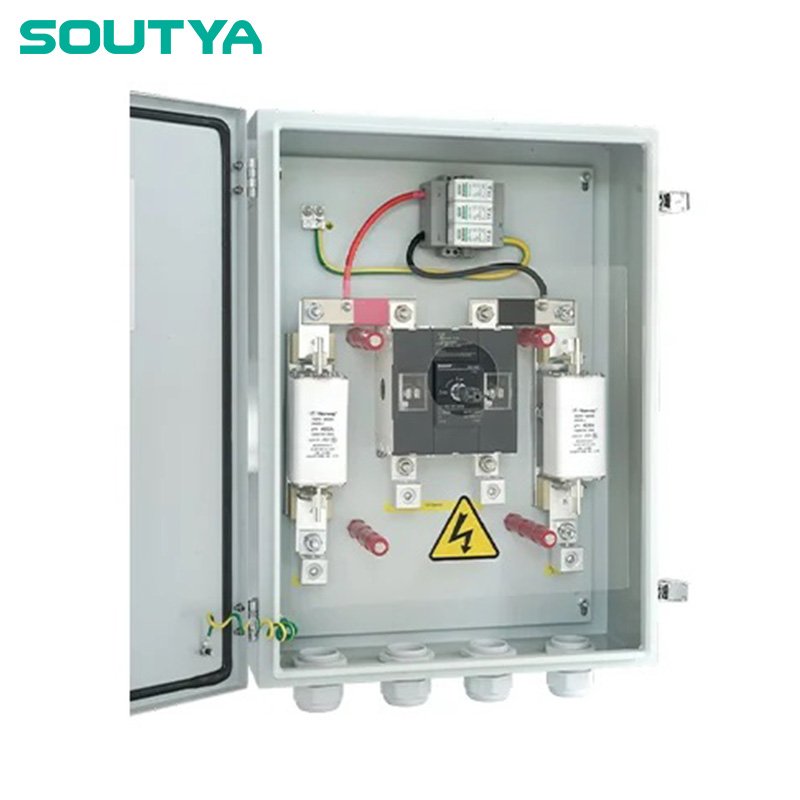
A standard combiner box simply merges multiple PV string inputs into a single output, typically with fuses or circuit breakers for overcurrent protection. A 12-in-1 DC AFCI combiner box adds arc fault detection and interruption at the combiner level. It continuously monitors the DC current waveform for characteristic signatures of arcing—such as high-frequency noise and sudden current changes—and trips the internal circuit breaker when an arc is detected. This design eliminates the need for separate AFCI devices on each string, reducing component count, wiring complexity, and cabinet footprint. The result is a compact, cost-effective solution for medium-to-large arrays with up to twelve strings.
The AFCI module within the combiner box uses a combination of current sensing, signal processing, and a microcontroller to distinguish between normal switching transients and hazardous arcs. It applies algorithms that comply with standards such as UL 1699B (Outline of Investigation for Photovoltaic DC Arc-Fault Circuit Protection) and IEC 63027 (DC Arc Fault Detection Devices). When a series or parallel arc is detected, the module sends a trip signal to an integrated DC-rated circuit breaker, isolating the affected strings. Many advanced units also provide visual or remote indication of the fault, enabling faster troubleshooting.
In commercial rooftops, carports, and ground-mount systems with string inverters or multi-string inverters, the 12-in-1 DC AFCI combiner box streamlines the balance-of-system design. Instead of deploying multiple smaller combiner boxes, a single enclosure handles up to twelve strings. This reduces material costs, installation labor, and the number of potential failure points. The integrated AFCI simplifies compliance with safety codes, as arc fault protection is provided at the combiner rather than requiring individual string-level devices. For plant operators, fewer enclosures mean easier maintenance and a cleaner layout.
Key standards for DC AFCI combiner boxes include:
Buyers should verify that the manufacturer's product is listed or certified to the applicable standard(s) for the installation region.
Q: Can a standard DC combiner box be upgraded with an external AFCI module?
A: In some cases, an external AFCI can be added upstream, but a dedicated 12-in-1 DC AFCI combiner box offers optimized integration, reduced wiring, and a single enclosure that simplifies approval and commissioning.
Q: Will the AFCI trip during normal inverter switching or lightning transients?
A: Modern AFCI modules use advanced algorithms to distinguish between arcing faults and normal transients. However, nuisance tripping can still occur if thresholds are set too sensitively. Choose a product with adjustable settings or field-proven performance.
Q: How many strings can a 12-in-1 DC AFCI combiner box handle?
A: As the name implies, it is designed for up to twelve string inputs, each typically fused or breakered separately. Some models can be used with fewer strings if needed.
Q: What maintenance is required for these units?
A: Routine visual inspection for signs of corrosion, loose connections, or moisture ingress is recommended. The AFCI self-diagnostics may also indicate device health. Follow the manufacturer's manual for specific intervals.
The 12-in-1 DC AFCI combiner box represents a practical evolution in PV system safety and integration. By combining high-density string combining with reliable arc fault detection and interruption, it helps system designers meet code requirements while reducing equipment count and installation complexity. For commercial and industrial projects seeking a balance between cost, safety, and scalability, this product provides a compelling solution. As with any critical electrical component, careful specification against recognized standards and proven supplier quality are essential to long-term performance.

Jack
Soutya