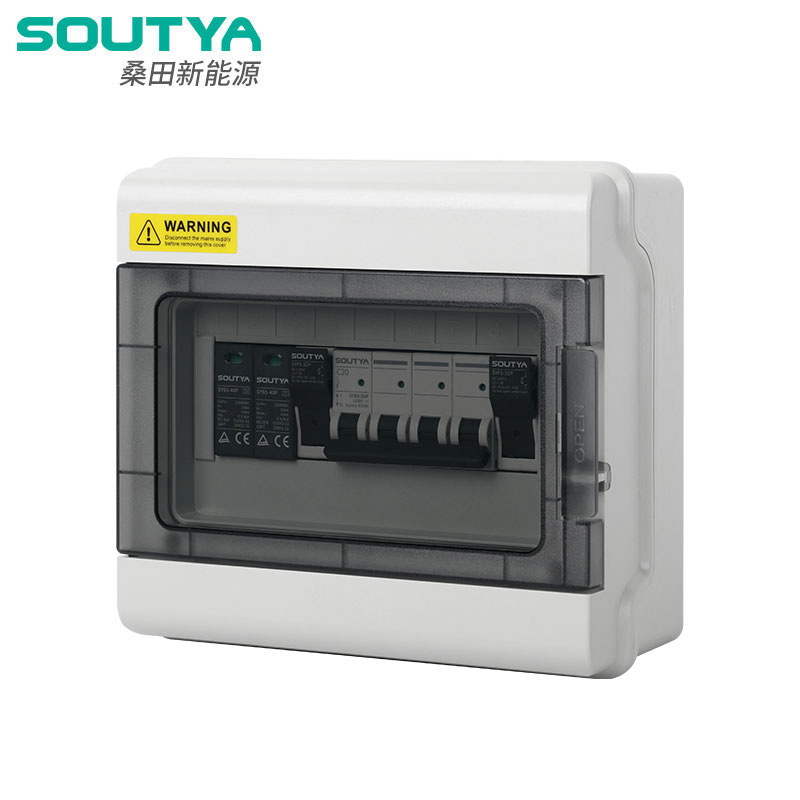
A PV Grid-connected Box is a critical component for safe and efficient solar power integration. This article explains its functions, selection criteria, and how Soutya's solutions meet industry standards.
Outline: This article covers the definition, safety role, reliability benefits, key specifications, type comparison, installation best practices, and standard compliance of PV grid-connected boxes.
A PV Grid-connected Box, also known as an AC combiner box or grid-connection junction box, is the interface between a photovoltaic inverter and the utility grid. It aggregates the AC output from multiple inverters or strings, provides overcurrent and surge protection, and includes a disconnection means for maintenance and emergency shutdown. Its core function is to ensure safe, code-compliant power transfer to the grid.
Safety is the primary driver. Without proper overcurrent protection, a fault downstream can cause equipment damage or fire. Surge protective devices (SPDs) inside the box protect against lightning-induced transients. A visible, lockable disconnect allows first responders to isolate the system. Standards such as IEC 60364-7-712 mandate these protective components for all grid-connected PV installations. A grid-connected box centralizes these safety measures in one enclosure.
Many authorities require grid-connected boxes to carry certification marks (e.g., CE, UL) to pass inspection. Verify that your supplier provides documented compliance.
By consolidating connections and protection, a grid-connected box reduces wiring errors and simplifies troubleshooting. It includes monitoring capabilities (e.g., current and voltage meters, communication ports) that provide real-time data on system performance. This allows operators to detect anomalies before they escalate. High-quality enclosures with IP65 rating protect electronics from dust and moisture, extending component life. Soutya's PV Grid-connected Box, for example, uses robust circuit breakers and SPDs tested for harsh environments.
Key specifications include:
| Type | Input Config | Protection | Typical Use |
|---|---|---|---|
| AC Combiner Box (Standard) | Multiple inverter AC outputs | MCB/SPD | Commercial rooftop, ground-mount |
| AC Distribution Box | Single or multiple inputs | MCCB/SPD with metering | Large-scale utility |
| Integrated Switchgear | Combines inverter and grid interface | Advanced protection and monitoring | Industrial, high-reliability |
Soutya's PV Grid-connected Box fits the standard AC combiner category, offering proven reliability and easy integration.
Installation must follow manufacturer guidelines: proper cable sizing, torque settings, and grounding. Routine maintenance includes visual inspection for corrosion, loose connections, and indicator lights on SPDs. Test circuit breakers annually. Keep the enclosure closed when not in service. Following these practices ensures the box operates for decades.
Check for marks from recognized bodies. For grid-connected boxes, key standards include IEC 62548:2016 (PV array design) and IEC 60364-7-712:2017 (PV installations). These specify requirements for overcurrent protection, disconnect means, and SPDs. Some markets require additional arc-fault protection (UL 1699B). Ask your supplier for a declaration of conformity or test reports.
For a reliable, compliant PV Grid-connected Box, consider Soutya's range. View the product page for detailed specifications and ordering information.
[1] IEC 62548:2016. Photovoltaic (PV) arrays – Design requirements [S]. 2016.
[2] IEC 60364-7-712:2017. Low-voltage electrical installations – Part 7-712: Solar photovoltaic (PV) power supply systems [S]. 2017.
[3] Wang J, Liu Z, et al. A Lightweight, Transferable, Self-Adaptive Framework for Intelligent DC Arc-Fault Detection in PV Systems [J]. ArXiv:2603.25749, 2025.

Jack
Soutya