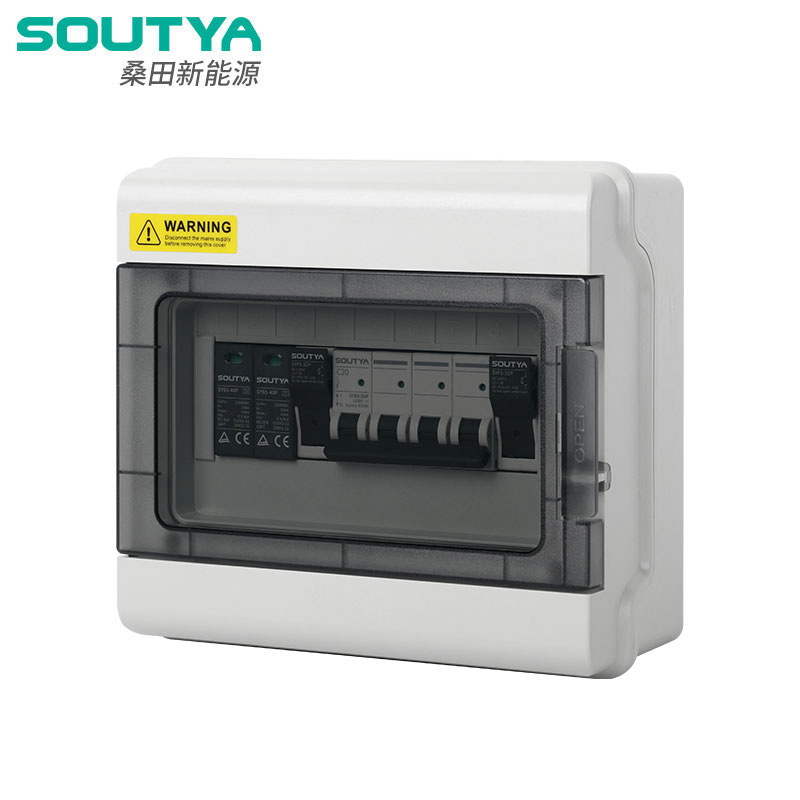
An AC Miniature Circuit Breaker protects electrical circuits from overcurrent and short-circuit faults. It automatically interrupts current flow when a fault is detected, preventing equipment damage and fire hazards. In commercial and industrial settings, MCBs are used in distribution boards, control panels, and lighting circuits. They provide reliable protection for wiring and connected devices.
Common causes of MCB failure include incorrect rating selection, poor coordination with downstream devices, and environmental stress such as heat or humidity. Thermal-magnetic trip units can degrade over time if exposed to frequent surge currents. Preventive measures include:
Internationally recognized standards ensure consistent performance and safety. Key references for AC MCBs include:
Certification to these standards guarantees that the MCB has passed type tests for temperature rise, dielectric strength, and short-circuit performance.
Breaking capacity (Icn) must equal or exceed the prospective short-circuit current at the point of installation. Typical values: 6kA, 10kA, 15kA for commercial buildings. For industrial panels with higher fault levels, 25kA or more may be required.
Trip curve selection depends on load type:
| Parameter | Importance | Typical Range |
|---|---|---|
| Rated voltage (Ue) | Must match system voltage | AC 230/400V |
| Rated current (In) | Matches load current | 1A to 63A |
| Breaking capacity (Icn) | Critical for safety | 6kA to 25kA |
| Trip curve | Ensures selectivity | B, C, D |
| Number of poles | Depends on phase | 1P, 2P, 3P, 4P |
| Energy limiting class | Reduces let-through | Class 3 recommended |
When evaluating suppliers, compare MCBs based on:
Request sample units for thermal and mechanical endurance tests under expected load conditions.
A qualified supplier provides technical support, delivery, and after-sales service. Look for manufacturers with ISO 9001 certification and a track record of supplying major contractors. Soutyaele offers a full range of AC Miniature Circuit Breakers compliant with IEC 60898-1, backed by engineering support for system design.
A: Not necessarily. Excessive breaking capacity may increase cost without added benefit if the fault level is low. Select Icn based on the calculated short-circuit current at the installation point.
A: C-curve works for most general loads, but B-curve is better for resistive loads and D-curve for high inrush loads like large motors. Misapplication may cause nuisance tripping or inadequate protection.
A: IEC 60898-1 covers MCBs for household and similar installations, while UL 489 applies to molded-case circuit breakers in North America. They have different test requirements and ratings. Choose based on target market.
For detailed specifications and pricing of Soutyaele AC Miniature Circuit Breakers, visit the product page: AC Miniature Circuit Breaker. Contact our engineering team for assistance with selection and application.
[1] IEC 60898-1. Electrical accessories - Circuit-breakers for overcurrent protection for household and similar installations - Part 1: Circuit-breakers for a.c. Operation [S]. 2019.
[2] IEC 60898-2. Electrical accessories - Circuit-breakers for overcurrent protection for household and similar installations - Part 2: Circuit-breakers for d.c. Operation [S]. 2019.
[3] GB/T 10963.1-2020. Electrical accessories - Circuit breakers for overcurrent protection for household and similar installations - Part 1: Circuit-breakers for a.c. Operation [S]. 2020.

Jack
Soutya