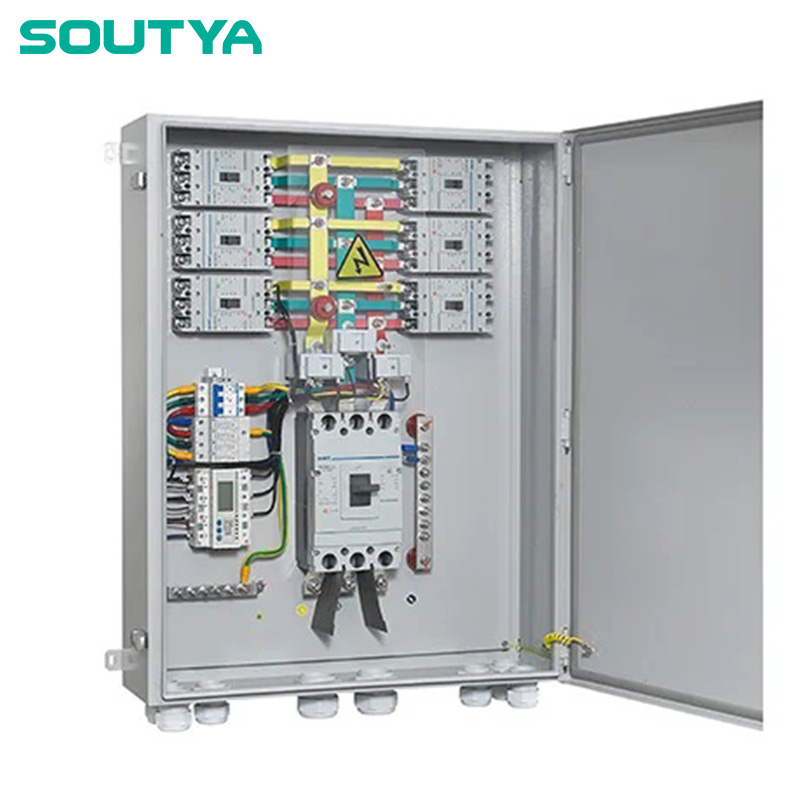
As solar and energy storage systems push toward higher voltages, a 1000V DC Surge Protector Device becomes a critical safeguard against transient overvoltages. This article explores the risks, standards, and selection criteria for these devices, helping engineers and procurement professionals make informed decisions. Find the right 1000V DC Surge Protector Device at Soutyaele.
High-voltage direct current (DC) systems, commonly found in large-scale photovoltaic arrays and battery energy storage systems (BESS), operate at voltages up to 1000V or higher. These systems are exposed to transient overvoltages caused by lightning strikes, switching operations, or grid disturbances. Without adequate surge protection, such overvoltages can lead to equipment damage, downtime, and safety hazards.
For instance, a lightning strike near a solar farm can induce high-voltage surges on DC cables that propagate to inverters, charge controllers, and battery management systems. The result can be catastrophic failure of sensitive electronics, fire risks, and costly repairs. A 1000V DC Surge Protector Device is designed to clamp these transients safely to ground, protecting downstream equipment.
Note: The risk is amplified in high-voltage DC systems because arc formation is more persistent than in AC; therefore, surge protectors must be rated for the system voltage and have proper DC arc extinguishing capability.
Reliability of a 1000V DC Surge Protector Device is defined by compliance with international standards. While surge protective devices (SPDs) have their own product standards (e.g., IEC 61643-31 for PV systems), the underlying switchgear and coordination principles are rooted in low-voltage directive standards.
Key references include:
Although these standards are not specific to SPDs, they form the baseline for system integration and safety. For DC-specific SPD performance, engineers should also consult IEC 61643-31 (PV surge protection) and UL 1449.
A 1000V DC Surge Protector Device typically uses metal oxide varistors (MOVs) or gas discharge tubes (GDTs) in a voltage-clamping configuration. Under normal operating conditions, the SPD presents a high impedance and negligible leakage current. When a transient overvoltage occurs, the SPD rapidly switches to a low impedance path, diverting the surge current to ground and limiting the voltage to a safe level.
For 1000V DC systems, the SPD must handle higher continuous voltages and repetitive surges. The device is designed with proper thermal management and arc-extinguishing features to safely disconnect the faulty component in case of end-of-life failure. Many modern SPDs include thermal disconnectors and status indicators.
Key Insight: The protection level (Up) of an SPD must be lower than the impulse withstand voltage of the protected equipment. For 1000V DC systems, typical Up values are around 2.5-3.0 kV.
When selecting a 1000V DC Surge Protector Device, engineers must evaluate several critical parameters. Below is a comparison table of typical values.
| Parameter | Typical Value for 1000V DC SPD | Importance |
|---|---|---|
| Maximum Continuous Operating Voltage (Uc) | ≥ 1000 V DC | Must exceed system voltage with margin |
| Nominal Discharge Current (In) | 20 kA (8/20 µs) | Determines surge current handling |
| Maximum Discharge Current (Imax) | 40-50 kA (8/20 µs) | Peak withstand capability |
| Voltage Protection Level (Up) | ≤ 2.5 kV | Must be lower than equipment insulation |
| Response Time | < 25 ns | Faster clamping for sensitive electronics |
| Operating Temperature Range | -40°C to +85°C | Ensures outdoor reliability |
Additionally, look for IP65 enclosure rating for outdoor installations, DC-specific certification, and integrated thermal disconnection. The 1000V DC Surge Protector Device at Soutyaele meets these criteria and is tested per relevant standards.
In B2B procurement, the cost of a component is often dwarfed by the cost of system failure. A substandard SPD may fail prematurely, not provide adequate protection, or even catch fire. Therefore, procurement teams should demand certified products from reputable manufacturers.
Certifications such as CE, TÜV, or UL indicate compliance with rigorous testing. Additionally, manufacturing quality assurance includes thermal cycling tests, surge endurance tests, and proper overvoltage coordination with circuit breakers (as per IEC 60947-2).
Working with a supplier like Soutyaele ensures that the 1000V DC Surge Protector Device is manufactured with high-grade MOVs, robust housing, and clear documentation.
No. AC surge protectors are not designed for DC voltage stress and lack proper DC arc extinguishing, which can lead to fire or failure. Always use a dedicated 1000V DC Surge Protector Device.
For solar applications, a nominal discharge current of 20 kA is typical for most installations. In areas with high lightning activity, consider a higher rating like 40 kA.
Yes, for complete protection. Install SPDs on the DC side (between panels and inverter) and on the AC side (grid connection). Both types must be coordinated.
SPDs with thermal disconnection may be end-of-life after a major surge. Check the indicator window. Typically, replacement is recommended every 5-10 years depending on surge exposure.
Yes, Soutyaele offers warranty coverage. Please consult the product datasheet for specific terms.
For engineers and procurement professionals seeking a dependable 1000V DC Surge Protector Device, the solution from Soutyaele combines robust performance, compliance with industry standards, and cost-effective pricing. Protect your high-voltage DC investment today.

Jack
Soutya