News

Why Choose a DC Isolator Box IP65 Enclosure with Three-String Fusing

2026-08-09 0 Leave me a message

This article explains the DC Isolator Box IP65 Enclosure Three Strings with Fuse from Soutya. As a combiner box for PV systems, it isolates and fuses three parallel strings in a weatherproof IP65 housing. The guide covers its design, selection factors, installation practices, and how to match it to your solar array.

Article Outline

  • Product definition and role in PV arrays
  • Safety and operational benefits of combining isolation and fuse protection
  • Weatherproof IP65 enclosure design and material considerations
  • Fuse sizing string voltage, current, and array configuration
  • Installation, commissioning, and maintenance best practices
  • asked questions for engineers and procurement

What Is a DC Isolator Box IP65 Enclosure Three Strings with Fuse?

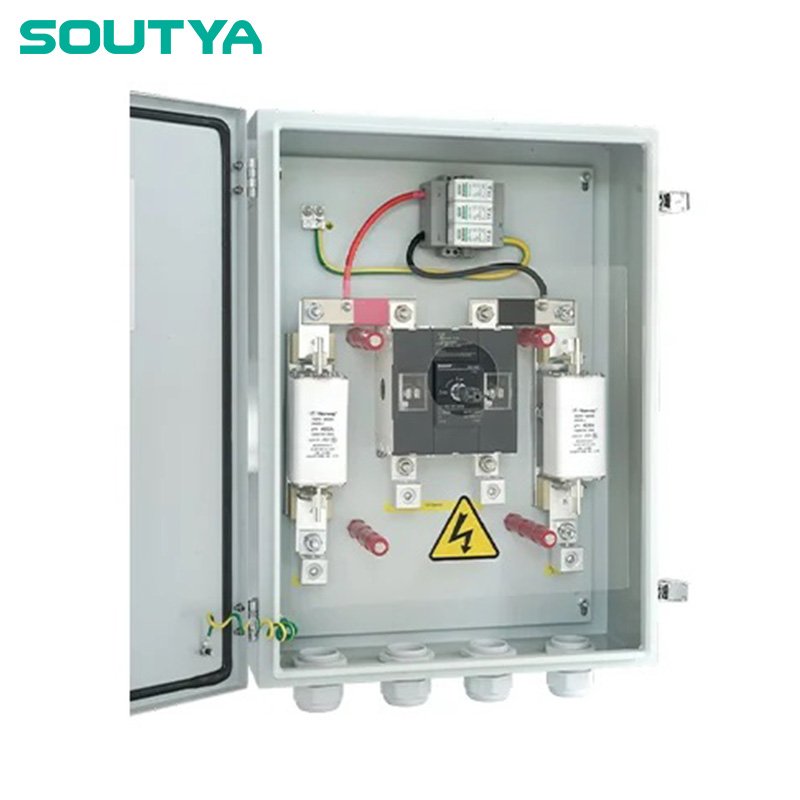
The **Soutya DC Isolator Box IP65 Enclosure Three Strings with Fuse** is a compact combiner box designed for photovoltaic systems where three independent DC input strings must be combined into one output circuit. It integrates a DC isolator (switch disconnector) and three fuse holders — one per string — inside an IP65-rated enclosure.

This component sits between the PV modules and the inverter. It provides a safe disconnection point for maintenance and emergency shutdown, while the fuses protect each string against overcurrent caused by reverse currents or fault conditions. The three-string architecture is common in residential and small commercial installations where array sizes range from 6 to 15 kW.

Soutya, as a manufacturer of electrical protection equipment, rates this unit for working voltages up to 1000 VDC, which aligns with the voltage limits of modern crystalline silicon modules. The enclosure is made of UV-stabilized engineered plastic or powder-coated steel, depending on the model variant, and all live parts are enclosed to prevent accidental contact.

Note: Always confirm the specific DC isolator box model’s voltage and current ratings against the string data on the module datasheet. Overrating is safer than underrating, for temperature-corrected string voltages.

Why Do Three-String PV Arrays Need a Dedicated Isolator and Fuse Combination?

In a multi-string PV array, each string generates its own DC current. If one string develops a short circuit or an internal ground fault, the remaining strings can feed back current into the faulty string. Without per-string fuses, this reverse current can exceed the module’s rated current and cause thermal damage or fire.

The IEC 62548:2016 standard for PV array design requirements specifies overcurrent protection for each parallel-connected string. A dedicated fuse per string ensures that a fault in one string is isolated without disrupting the other two. The DC isolator adds a visible break for safe manual operation during installation, inspection, or emergency response.

, a combined isolator-and-fuse box reduces the number of separate components in the DC circuit, minimizing potential wiring errors and junction points. The Soutya DC Isolator Box IP65 Enclosure Three Strings with Fuse replaces three individual fuse holders plus a separate isolator, saving space and cost.

For engineers selecting protection, the interaction between the fuse’s breaking capacity and the isolator’s switching ability must be verified. The fuse clears a fault while the isolator provides an intentional, load-break disconnection. Both functions are essential for safe operation and compliance with IEC 62548:2016.

How Does the IP65 Enclosure Protect the DC Isolator and Fuses in Outdoor Installations?

IP65 means the enclosure is dust-tight (IP6X) and protected against low-pressure water jets from any direction. This makes the Soutya DC Isolator Box suitable for outdoor roof-mounted or ground-mounted PV installations, where rain, condensation, and dust are constant threats.

The enclosure achieves this sealing through a silicone gasket or EPDM seal the lid, plus cable glands that maintain the integrity of the IP rating when wires enter. The internal components — the isolator contacts and fuse carriers — are mounted on a plate that resists corrosion and tracks the thermal environment inside the box.

Temperature rise is a critical design factor. When three strings carry current simultaneously, the heat generated by the fuse elements and contact resistance must be dissipated without accelerating the aging of the insulation. The Soutya enclosure design includes ventilation channels that prevent internal pressure build-up while preserving the IP65 barrier. These details extend the service life of the switch contacts and fuse clips.

For installations exposed to coastal salt spray or industrial pollutants, the powder-coated or anodized finish of the enclosure provides additional corrosion resistance. The DC isolator handle is also designed to be operable with gloves, and its position indicator remains visible even with the lid closed.

Which Fuse Ratings and String Configurations Suit Your PV System?

Choosing the correct fuse rating for each string is a balance between carrying the normal maximum current and clearing fault currents . For a standard 72-cell module with a short-circuit current (Isc) of 9 A, the fuse rating should be between 15 A and 20 A, depending on the module’s maximum series fuse rating.

The Soutya DC Isolator Box accommodates three strings, each fitted with a 10×38 mm cylindrical fuse (common for PV). The fuse holder accepts up to 20 A per string, and the output circuit has a rated current of up to 63 A, providing a total capacity of 3×20 A = 60 A at the output, assuming a 20% derating margin.

Here is a comparison table of common three-string combiner box configurations:

String VoltageMax String CurrentFuse RatingOutput Circuit Load
1000 VDC12 A15 A36 A
1000 VDC15 A20 A45 A
1500 VDC10 A12 A30 A

For strings with more than three parallel inputs, a different combiner box with more fuse holders would be required., a two-string box may be adequate for smaller residential systems. The three-string model offered by Soutya is the sweet spot for cost efficiency because it uses a single enclosure for both isolation and fuse protection while leaving headroom for a fourth string if needed (though the fuse holders are three).

How to Install and Maintain the Soutya DC Isolator Box for Long-Term Reliability?

Installation begins by mounting the enclosure on a solid vertical structure, using stainless steel fasteners. The cable entry points should be directed downward to minimize moisture ingress via the glands. Each string’s positive and negative cables are routed into the box, with the positive line passing through its dedicated fuse holder and the negative line connected to the output busbar.

Before energizing, measure the insulation resistance of each string and verify the polarity. The DC isolator should be operated a few times without load to confirm smooth action. During commissioning, clamp meters are used to measure string currents to ensure that no string is heavily imbalanced — a sign of a possible ground fault or module mismatch.

Maintenance checks are straightforward: every six months, inspect the sealing gaskets for cracks, check for condensation inside the enclosure, and verify that all fuse caps are tight. Tighten the terminations once a year, as heating and cooling cycles can loosen screws. If a fuse has blown, replace it with the same type and rating and investigate the cause before re-energizing.

The contact performance of the DC isolator is related to its long-term reliability. A study on contact electrodes of low-voltage DC switches (see reference [2]) shows that materials with silver alloy layers exhibit lower arc erosion after thousands of operations. The Soutya DC Isolator Box uses silver-tipped contacts in its rotary switch to reduce contact resistance and extend mechanical life beyond 10,000 operations.

Asked Questions

What is the difference between a DC isolator box and a combiner box?

A combiner box consolidates multiple PV strings into one output and includes fuses or circuit breakers. A DC isolator box is focused on providing a manual disconnection point. The Soutya product combines both functions in one enclosure, making it a type of combiner box with isolation capability.

Can this box handle 1500 VDC systems?

The standard version is rated for 1000 VDC. Some industrial variants support 1500 VDC, but the cable glands and fuse holders must be derated. Check the label or consult Soutya for direct replacement parts before connecting to a 1500 VDC array.

How many strings can be fused inside this enclosure?

This specific model is designed for exactly three strings. Each string has its own fuse holder and terminal. The positive and negative connections from each string are labeled.

Is the IP65 rating sufficient for humid coastal areas?

IP65 protects against water jets and dust, but continuous high humidity can still cause condensation if temperature swings are extreme. For coastal environments, the anodized/powder-coated enclosure option is recommended, and periodic checks of the gasket are essential.

Soutya DC Isolator Box IP65 Enclosure Three Strings with Fuse

References

[1] IEC 62548:2016. Photovoltaic (PV) arrays — Design requirements [S]. International Electrotechnical Commission, 2016.

[2] Aging Characteristics of Contact Electrodes of Low Voltage DC Switches — A study on material performance under DC arcing [J]. Energies, 2021.

[3] Simulation Study on Arc Motion Process of DC Miniature Circuit Breakers — MHD model for DC arc interruption [J]. Physics of Fluids, 2023.

Need a Reliable DC Combiner Box for Your PV Project?

The Soutya DC Isolator Box IP65 Enclosure Three Strings with Fuse is available for OEM and wholesale orders. Contact Soutya for datasheets, custom fuse ratings, and bulk pricing.

Related News
Leave me a message
X
We use cookies to offer you a better browsing experience, analyze site traffic and personalize content. By using this site, you agree to our use of cookies.Privacy Policy
RejectAccept