News

What Is an AC Combiner Box 6 In 1 Out and Why Is It Essential for Distributed Systems

2026-06-20 0 Leave me a message

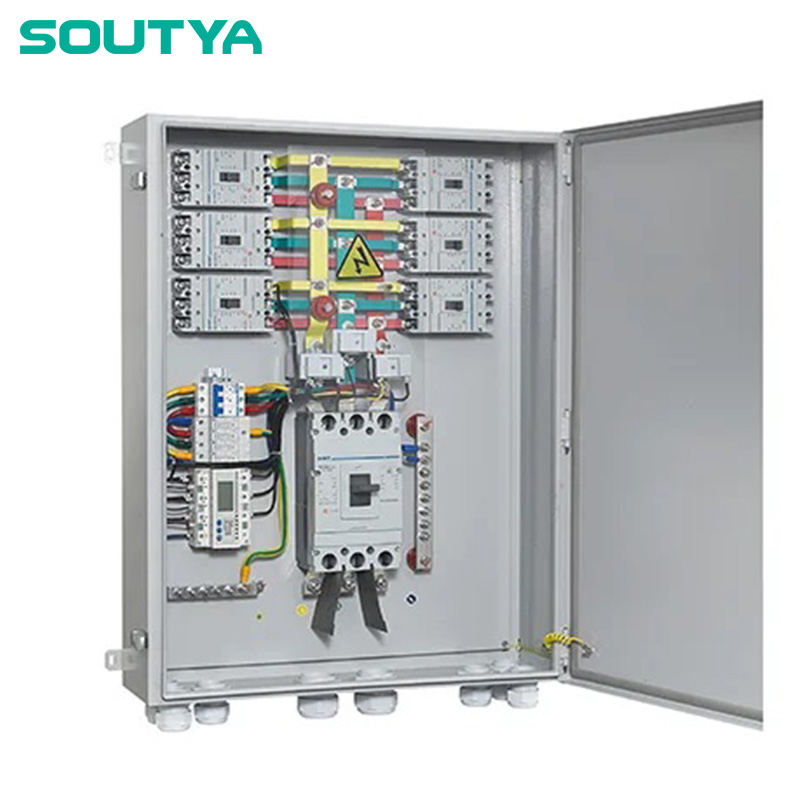
An AC Combiner Box 6 I

ParameterAC Combiner Box 6 In 1 OutTraditional Solution
Rated VoltageCustomizableStandard
Protection LevelHighMedium
InstallationEasyComplex
n 1 Out consolidates six AC input circuits into one output, simplifying wiring, reducing cost, and improving safety in commercial solar, storage, or industrial distribution. Soutyaele's AC combiner box offers robust protection with circuit breakers, surge protection, and monitoring options. This article explains its function, selection criteria, and the standards that ensure reliable performance.

Note: Proper selection and installation of AC Combiner Box 6 In 1 Out is critical for system safety and performance. Always refer to the manufacturer specifications and relevant industry standards.

What does an AC Combiner Box 6 In 1 Out do in a power system?

An AC Combiner Box 6 In 1 Out is an enclosure that gathers six AC power inputs— from inverters, generators, or other AC sources—and combines them into a single output feeder. This output then connects to a transformer, load center, or utility grid. The box contains overcurrent protection devices (circuit breakers or fuses) for each input, a main switch, surge protective devices, and optional monitoring terminals. Its primary function is to manage multiple AC circuits in a safe, organized manner, reducing field wiring errors and simplifying maintenance.

Why choose a 6-input configuration over separate distribution?

Using a single 6-in-1-out AC combiner box offers several advantages over installing six individual distribution points:

  • Space savings: One enclosure instead of six reduces footprint in equipment rooms or outdoor areas.
  • Lower installation cost: Fewer conduits, cables, and terminations lower material and labor expenses.
  • Simplified troubleshooting: Centralized status indication and labeling speed up fault identification.
  • Enhanced protection coordination: Factory-assembled breakers with matched ratings ensure selective coordination between input and output circuits.
  • Easier compliance: A pre-assembled box with certified components helps meet local codes (e.g., NEC 690 for solar).

For commercial solar plants with multiple string inverters or battery storage systems with multiple PCS units, a 6-input combiner box is a cost-effective choice.

How does an AC combiner box protect circuits and improve reliability?

An AC combiner box 6 in 1 out provides layer protection:

  • Overcurrent protection: Each input branch is protected by a molded-case circuit breaker (MCCB) or miniature circuit breaker (MCB) rated per IEC 60898-1 or IEC 60947-2. These devices interrupt fault currents to prevent cable overheating.
  • Surge protection: Type 2 surge protective devices (SPDs) clamp transient overvoltages from lightning or switching, safeguarding downstream electronics.
  • Short-circuit protection: The main output breaker isolates the entire box in case of a major fault.
  • Arc-flash mitigation: Enclosures with proper IP ratings and arc-resistant designs reduce risks during maintenance.

Reliability is further improved by using high-quality terminals, busbars with adequate cross-sections, and thermal management (ventilation or louvered doors) to dissipate heat from continuous currents.

Which components are critical in a 6-in-1-out AC combiner box?

A well-designed AC combiner box includes:

  • Six input breakers: Each rated for the inverter output current (e.g., 20A to 63A per branch).
  • One main output breaker: Sized to handle the total combined current ( 6 × branch rating).
  • Busbar system: Copper or tinned copper busbars with proper current-carrying capacity and spacing.
  • Surge protective device (SPD): a Type 2 4-pole SPD for 3-phase systems.
  • Monitoring unit (optional): Current transformers, voltage sensors, and a meter for remote energy management.
  • Enclosure: Steel or stainless steel, rated IP65 for outdoor or IP54 for indoor use, with locking handle.

Soutyaele's AC combiner box 6 in 1 out uses ABB/Schneider breakers and Phoebe SPDs, ensuring field-proven reliability.

What standards should a qualified AC combiner box comply with?

Industrial-grade AC combiner boxes must meet multiple international and national standards:

  • IEC 60947-4-1 for contactors and motor-starters if control functions are included.
  • IEC 60898-1 for AC circuit breakers used in overcurrent protection.
  • IEC 60947-2 for molded-case circuit breakers for higher currents.
  • GB/T 14048.2-2020 (Chinese equivalent to IEC 60947-2) for low-voltage switchgear.
  • IEC 61439 series for low-voltage switchgear and controlgear assemblies.

These standards ensure that the enclosure, busbars, and devices withstand thermal, mechanical, and dielectric stresses. Always ask for test certificates before procurement.

How to select the right AC combiner box for your project?

When evaluating an AC combiner box 6 in 1 out, consider these parameters:

  • Voltage rating: 400V/480V AC (3-phase) or 230V (1-phase). Match the system voltage.
  • Current rating: Sum of all input currents (plus 20% headroom). E.g., six 32A inputs → main breaker at 250A.
  • Number of inputs: 6 in 1 out is fixed; some vendors offer expandable solutions.
  • Protection devices: Confirm breaker type (MCB/MCCB), breaking capacity (≥10kA for commercial), and number of poles.
  • Environmental conditions: Ingress protection (e.g., IP65 for outdoor), ambient temperature range, UV resistance.
  • Certifications: CE, CB, UL (if required for your market).
  • Monitoring needs: Do you require remote data logging? Choose a box with built-in meter or CT inputs.

For example, Soutyaele's AC combiner box 6 in 1 out is available in IP65 enclosures with optional WIFI monitoring, suitable for commercial solar rooftops.

Asked Questions

Can an AC combiner box 6 in 1 out be used for three-phase inputs?
Yes. The box can be configured with 3-pole breakers for three-phase inputs, or 1-pole breakers for single-phase inputs. The output can be a single three-phase feeder.
What is the difference between an AC combiner box and a DC combiner box?
A DC combiner box merges DC strings from solar panels, using DC-rated breakers. An AC combiner box merges AC sources (inverters, generators) and uses AC-rated breakers. AC boxes also include SPDs rated for AC systems.
How do I choose between fuse and circuit breaker for each input?
Circuit breakers offer resettable protection and visual indication; fuses are cheaper but require replacement. For commercial systems, breakers are preferred for convenience and coordination.
Can I add more inputs later if I buy a 6-in-1-out box?
Not . If expansion is planned, consider a modular combiner box that allows adding branch units. Otherwise, oversize the box.
Does Soutyaele provide custom configurations for AC combiner boxes?
Yes. Soutyaele can customize the number of inputs, breaker brands, SPD type, and monitoring options based on project specifications. Contact their sales team for details.

For reliable AC power consolidation, explore Soutyaele's AC combiner box 6 in 1 out. Built with certified components and robust enclosures, it simplifies installation and meets international standards. View the product page for specifications and request a quote for your next project.

References

  1. IEC 60947-4-1. Low-voltage switchgear and controlgear - Part 4-1: Contactors and motor-starters [S]. 2020.
  2. IEC 60898-1. Electrical accessories - Circuit-breakers for overcurrent protection for household and similar installations - Part 1: Circuit-breakers for a.c. Operation [S]. 2019.
  3. GB/T 14048.2-2020. Low-voltage switchgear and controlgear - Part 2: Circuit breakers [S]. 2020.

AC Combiner Box 6 In 1 Out

Related News
Leave me a message
X
We use cookies to offer you a better browsing experience, analyze site traffic and personalize content. By using this site, you agree to our use of cookies.Privacy Policy
RejectAccept