Desert Sun Solar Installations, a commercial solar contractor based in Arizona, installs rooftop photovoltaic and battery storage systems for warehouses and retail facilities across the southwestern United States. The company completes 15 to 20 projects each year, with system sizes ranging from 80 kW to 250 kW. A crew of 12 technicians handles design, mounting, wiring, and grid interconnection. Labor productivity affects profitability because most projects are fixed-bid contracts.
Before switching to the Soutya Single Phase DC+AC Combiner Box 600V 1000V 2 In 2 Out Industrial Box, every project required two separate enclosures. Technicians installed a DC combiner box near the solar array and a second AC distribution box near the inverter or load center. The two boxes demanded extra wall space, separate conduit runs, and careful coordination between photovoltaic and AC wiring. On average, each site took eight additional labor hours for mounting and interconnecting the two boxes.
Wiring errors between the DC and AC sections caused ground faults and reverse-polarity issues, leading to rework and callbacks. Over the past year, these problems added roughly $450 in rework cost per project and delayed commissioning by two days on 40% of the jobs. Inspection failures related to grounding and conductor separation were common, and the crews had to dismantle conduit and replace mislabeled terminals in the field.
The company evaluated three alternatives: a custom-built panel using off-the-shelf breakers, two compact boxes from a competitor, and the Soutya Single Phase DC+AC Combiner Box. Custom enclosures required electrical engineering review and did not carry the needed certifications. The competitor's two-box design still used separate raceways and wall openings, so it did not address the root cause of the extra labor.
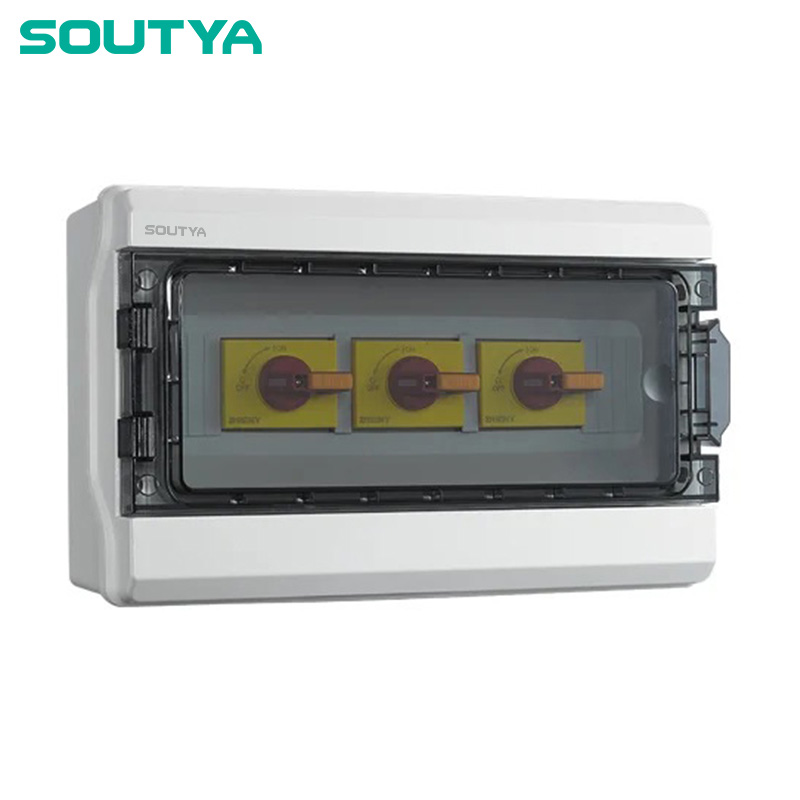
The Soutya box combined DC string combining and AC branch circuit protection in a single IP65-rated enclosure. Its 2-in-2-out configuration matched the company's standard system layout of two DC strings feeding one inverter and one AC output. The unit accepts 600V or 1000V DC input, covering the module voltages used across the project portfolio. Integrated surge protection devices and fused inputs met the requirements of IEC 61643-11 and IEC 62548. The enclosed design simplified grounding, reduced conduit length, and eliminated the second mounting location.
The implementation began with a two-week pilot on three completed projects. The crew replaced two separate boxes with one Soutya unit on each site. Mounting took place at a single location near the inverter. DC and AC cables were routed into the dedicated entry ports and terminated on the labeled terminal blocks. The internal grounding bus reduced the bonding work for DC and AC grounds, which had been the most common source of inspection violations.
One issue surfaced when an inspector questioned the separation between DC and AC conductors inside a combined enclosure. The Soutya documentation included physical barrier specifications and creepage distances, and the box passed inspection without modification. After the pilot, the company updated its standard electrical design to use the Soutya box on every new project. The crew also standardized cable entry layouts, which shortened the sealing time on rooftop installations.
Results were measured across seven projects completed in the first two months after the switch. Average installation time per site dropped from 31 hours to 20 hours, a 35% reduction. Wiring labor hours fell by 40% because technicians no longer built separate DC and AC conduit runs. Rework caused by wiring errors decreased from five incidents over the previous seven jobs to zero.
Material and labor savings totaled $320 per site, adding up to more than $10,000 annually for the company's project volume. Commissioning delays related to enclosure installation disappeared. The average time from start of installation to grid interconnection shortened by two days, allowing the company to complete an additional project each quarter.
"We were cautious putting DC and AC in the same box, but the Soutya unit simplified our installs so much that our crew now requests it on every new project. The wiring errors we used to chase are gone." — Operations Manager, Desert Sun Solar Installations
If the company were to redo the project, it would order the optional cable gland kit from Soutya to further reduce sealing time on outdoor rooftop installations. The kit is designed for the box's entry port dimensions and would eliminate the need for custom adapters.
This installation follows the design requirements of IEC 62548:2016 for photovoltaic arrays and the surge protection provisions of IEC 61643-11:2011 for low-voltage DC systems.


Jack
Soutya